
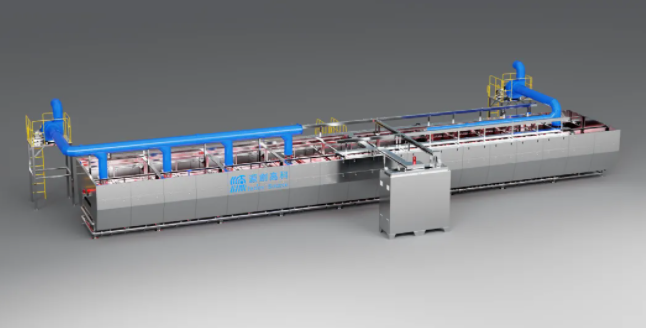
Microwave heating of materials began in the 1960s and 1970s; its best application setting is not on Earth but in space, where zero gravity, high vacuum, no fuel and high-volume continuous heat treatment are almost tailor-made for the technology.
Microwave heating of materials emerged in the 1960s and 1970s and has since become an important branch of advanced materials processing. Yet when we ask where this technology is best applied, the answer is not on Earth — it is in space.
A heat-treatment environment with zero gravity, high vacuum, no fuel consumption and continuous high-volume processing is almost tailor-made for microwave heating. Hunan Innov-source reviews the international research trajectory and the terrestrial conversion of this technology, hoping to offer a reference for forward-looking research in China.
I. Origins: From Terrestrial Process to Space Scenario
Microwave heating generates volumetric heat through a high-frequency electromagnetic field without combustion, heating quickly with high controllability — qualities that become indispensable process conditions in zero-gravity, high-vacuum space environments.
Microwave heating uses a high-frequency electromagnetic field to make polar molecules and dielectric-loss media move rapidly, generating heat throughout the material volume. Unlike conventional kilns that rely on conduction, convection and radiation, it needs no combustion, heats quickly, is highly controllable and uses energy efficiently. These advantages on Earth become indispensable process conditions in the zero-gravity, high-vacuum environment of space.
II. Why Space Is the Ideal Application Environment
Space uniquely combines zero gravity, high vacuum, no fuel and continuous high-volume processing, making microwave sintering, microwave vacuum heating and microwave high-temperature heat treatment key routes for space materials fabrication.
Space offers four conditions rarely available together on Earth: zero gravity eliminates sedimentation and stratification in melts and powders, yielding more uniform microstructures; high vacuum naturally provides a clean, oxygen-free atmosphere, saving the energy cost of protective gas and vacuum furnaces; no combustion is needed, as energy couples directly into materials as electricity; and continuous, high-volume material processing matches the modular, continuous nature of microwave equipment. For these reasons, microwave sintering, microwave vacuum heating and microwave high-temperature heat treatment are regarded as key routes for space materials fabrication.
III. International Research: A Validated Technical Pathway
From the 1970s to around 2010, Penn State University's microwave processing laboratory produced results in lunar-regolith building materials, metal extraction, transparent ceramic windows, amorphous silicon, boron carbide and silicon carbide armor ceramics, and NASA microgravity gallium nitride single-crystal growth.
In the 1970s, the United States established a microwave processing research laboratory at the Materials Research Institute of Penn State University. Research continued until around 2010, generating extensive results for US space programs and military advanced-materials development: building materials from simulated lunar regolith, extracting and refining metals from regolith, high-temperature microwave sintering of transparent ceramic windows for Air Force hypersonic air-to-air missiles, preparation of amorphous silicon and ferrite materials under pure electric or pure magnetic fields by the Navy, sintering of boron carbide and silicon carbide composite armor ceramics by the Army, and NASA growth of gallium nitride single crystals under microgravity. This body of work demonstrates the maturity of microwave heating in solid-state synthesis, advanced ceramics and semiconductor crystal growth.
IV. Terrestrial Conversion and Forward-Looking Recommendations
Hunan Innov-source has converted these principles into industrial equipment for microwave sintering, roasting, powder calcination, solid-state synthesis and deep drying below 1 ppm moisture, and recommends forward-looking research aligned with crewed lunar, space-station and deep-space programs.
Hunan Innov-source has translated these proof-of-concept results into industrial equipment: microwave sintering and roasting, powder calcination, solid-state synthesis, advanced materials heat treatment, and deep drying to below 1 ppm moisture for fine chemicals and metal powder metallurgy. We recommend systematically evaluating microwave material-processing technologies against China's crewed lunar landing, space station and deep-space base plans, pursuing forward-looking research in lunar-regolith building materials, in-situ metal extraction and microgravity crystal growth, and moving relevant processes toward on-board space-station validation. Space technology ultimately feeds back to Earth — today's microwave kilns and continuous heat-treatment equipment serving advanced materials manufacturing are the terrestrial extension of this technical pathway.